
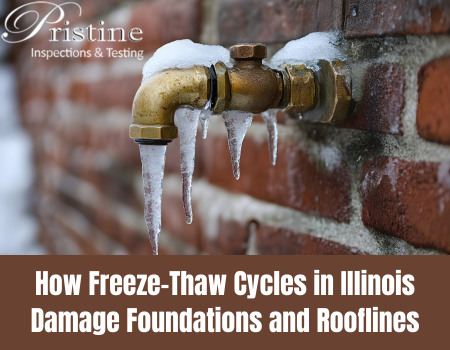
Illinois doesn’t get talked about as a hard climate for houses but it should. People think extreme weather and they picture hurricanes or Arizona summers. What happens in a Naperville subdivision or a Rockford neighborhood over a single winter is quieter than that and in some ways more destructive — not because any one event is dramatic but because nothing gets a chance to recover. Freeze, thaw, freeze again. Forty or fifty cycles between November and March in a bad year. The house just absorbs it, over and over, until something gives.
Water is what does the actual work. It finds a small opening — doesn’t need to be much, a hairline crack, a gap where caulk has pulled back slightly — gets in, freezes, and expands about nine percent. Same crack, forty times. What starts as something you could barely see with a flashlight in October is a different conversation by April.
Expansion Cracks
Vertical cracks in a foundation wall are usually shrinkage — concrete curing, normal settling, not a structural conversation. Diagonal cracks at 45 degrees and horizontal cracks are different. Those are pressure. Freeze-thaw expansion in block and poured foundations creates both, slowly, over multiple seasons, in a way that’s easy to dismiss at each individual stage because no single winter looks that bad.
The thing about expansion cracks is how they telegraph what’s coming before the serious damage arrives. Efflorescence on the basement wall — that white chalky film — means water is moving through the concrete regularly enough to carry minerals with it. That’s not cosmetic, that’s a pattern. A crack that was hairline last spring and is now wide enough to fit a finger in didn’t get there overnight. Freeze-thaw worked on it all winter while nobody was paying attention because the basement seemed fine and nobody goes down there with a flashlight in February. By the time there’s visible bowing in a block wall the cycle has been running for years.
Flashing Failure
Flashing is the metal installed at every roof transition — chimney bases, valleys, dormers, anywhere the roof meets a vertical surface. It works until the materials around it stop cooperating, which in Illinois happens on a schedule. The roofing material and the flashing expand and contract at different rates. The sealant holding everything tight gets cycled into brittleness. A connection that was solid in September has a gap in it by February and that gap is sitting under snow and ice for the rest of winter.
The damage from flashing failure almost never shows up when it’s actually happening. It shows up as a water stain on a ceiling in May during the first heavy spring rain, which feels like a roof problem but is actually a January problem that just took a few months to become visible. By then there’s usually damage to the sheathing underneath, sometimes to framing, in a spot that’s been wet and frozen and wet again since before Christmas. The flashing inspection that would have caught it takes twenty minutes on the roof in October. Most people skip it because the ceiling looked fine last spring.
Drainage Inspection Points
Gutters in this climate are doing real structural work and most of them aren’t maintained like it. Ice dams form when heat escapes through the roof, melts the snow above, and that water runs down to the cold eaves and refreezes. It backs up under shingles, under flashing, into every small gap the freeze-thaw cycle has already been opening up all winter. The gutter fills with ice and either pulls away from the fascia or just sits there heavy and useless while water finds its way behind it.
Downspout extensions are the thing nobody checks until there’s water in the basement and suddenly everyone’s an expert on foundation drainage. Water discharging at the foundation instead of being carried away saturates the soil right against the wall, that soil freezes, expands, pushes. Grading shifts over years without anyone noticing — what was sloping away from the house when it was built is often flat or slightly toward it a decade later. A drainage inspection after winter isn’t complicated. Gutters cleaned, downspout extensions intact and actually moving water away from the house, grading walked and eyeballed. Most people do none of it until something fails, which in Illinois is usually a matter of when rather than if.